Payment Gateways
In CLIENTXCMS, a payment gateway corresponds to a financial transaction processing system that you offer to your customers in your store. The objective is clear: offer secure, diverse payment methods adapted to your clientele. Good payment gateway configuration allows your customers to easily pay for their orders while guaranteeing transaction security.
Each gateway can be fully customized: display name, minimum amount, visibility status, connection parameters, etc.
You can manage payment gateways from:
Settings > Store Settings > Payment Gateways
A diversity of payment methods significantly increases your conversion rate. The more options you offer your customers, the more likely they are to complete their purchase.
Why use multiple payment gateways?
Payment gateways are essential for your store's proper functioning. They concretely represent the means your customers have to pay you — whether by credit card, PayPal, bank transfer, or store credit.
Configuring multiple gateways allows you to:
- Meet the payment preferences of all your customers
- Reduce cart abandonment by offering alternatives
- Secure your transactions with reliable systems
- Optimize your transaction costs based on amounts
It's like having multiple checkouts in a store 🏪 — some customers prefer to pay cash, others by card. The more choices you offer, the more you retain your clientele.
Available Gateways
CLIENTXCMS natively supports several popular payment gateways:
📄️ Mollie (Card Payment)
The Mollie payment gateway allows you to accept payments via credit cards.
📄️ Balance (Store Credit)
The Balance gateway in CLIENTXCMS corresponds to the internal store credit system that allows your customers to use a prepaid balance to pay for their orders.
📄️ Bank Transfer
The Bank Transfer gateway in CLIENTXCMS corresponds to the traditional bank transfer payment system that allows your customers to pay for their orders by directly transferring funds from their bank account to yours.
📄️ PayPal
The PayPal gateway in CLIENTXCMS corresponds to the integration of the world's most popular online payment solution that allows your customers to pay for their orders with their PayPal account or credit card via PayPal's secure interface.
📄️ PayPal Express Checkout
The PayPal Express Checkout gateway in CLIENTXCMS corresponds to the modern and optimized version of PayPal integration using the REST API to offer a smooth and secure payment experience to your customers.
📄️ Stancer (Card Payments)
The Stancer gateway in CLIENTXCMS corresponds to a modern French card payment solution that allows your customers to securely pay for their orders with their Visa, Mastercard, or other cards.
📄️ Stripe (Card Payments)
The Stripe gateway in CLIENTXCMS corresponds to the integration of the world-leading American payment solution that allows your customers to pay for their orders with their credit card via one of the most advanced platforms on the market.
Gateway Types
Gateways fall into several categories:
| Gateway Type | Description | Examples |
|---|---|---|
| Credit Cards | Direct payment by credit/debit card | Stripe, Stancer |
| Wallets | Online payment solutions | PayPal |
| Transfers | Traditional bank transfers | Bank Transfer |
| Store Credit | Internal balance system | Balance |
Gateway Configuration
Accessing Configuration
To configure a payment gateway:
- Go to
Settings>Store Settings - Select the "Payment Gateways" section
- Choose the gateway you want to configure
Common Parameters
Each gateway has identical basic settings:
Name | (text)
The gateway display name as it will appear to your customers during payment.
Minimum Amount | (amount)
Minimum amount required for this gateway to be offered to customers.
Status | (dropdown menu)
Defines the gateway's visibility and availability:
- Active: Visible and usable by all customers
- Unlisted: Accessible only to administrators for testing
- Hidden: Completely invisible to everyone
Some gateways require specific connection parameters (API keys, merchant IDs, etc.). Consult each gateway's documentation for required fields.
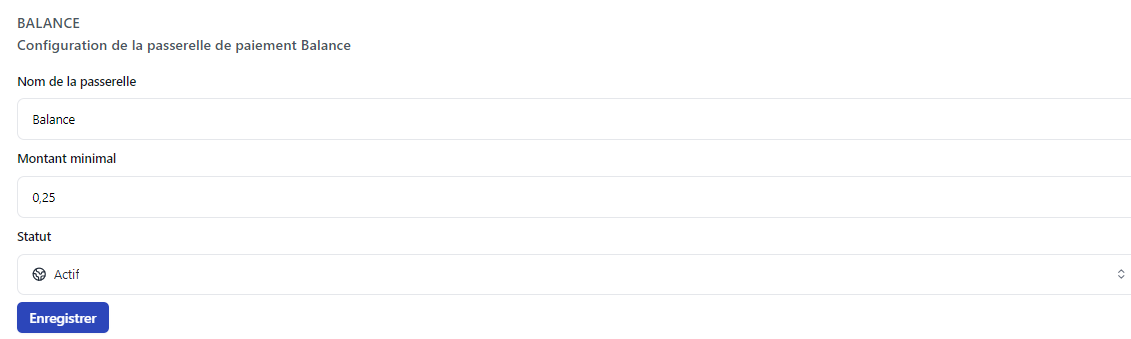
Configuration Example
Here's a configuration example for the Balance (store credit) gateway:
This gateway allows customers to use their store credit to pay for their orders.
Gateway Status
The status determines each gateway's visibility and accessibility:
| Status | Visibility |
|---|---|
| Active | Visible and usable by everyone |
| Unlisted | Accessible to administrators only |
| Hidden | Completely invisible |
Use the "Unlisted" status to test a new gateway before making it public.
Invoice Management
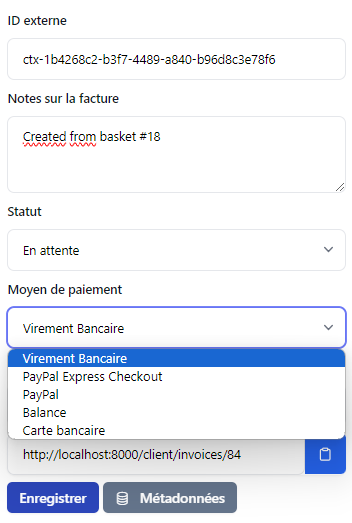
Changing an Invoice's Gateway
You can change the payment method for an existing invoice:
- Go to the "Invoices" section
- Select the invoice to modify
- Change the payment gateway in the invoice details
- Save the modifications
Modifying an invoice's gateway may affect the ongoing payment process. Make sure the customer is informed.
Advanced Configuration
Minimum Amounts
Each gateway can have a different minimum amount:
- Useful to avoid fees on small transactions
- Helps direct customers to the most cost-effective gateways
- Improves user experience by hiding irrelevant options
Currency Management
CLIENTXCMS automatically handles:
- Currency conversion if necessary
- Amount display in the customer's currency
- Exchange rates in real-time
Payment Security
Best Practices
- Use only PCI-DSS certified gateways
- Enable 3D Secure verification when available
- Regularly monitor suspicious transactions
- Keep configurations and API keys up to date
Compliance
All integrated gateways comply with:
- PCI-DSS standards for card security
- GDPR regulation for data protection
- PSD2 requirements for strong authentication.
Configuration by Gateway
Each gateway has its own detailed documentation:
- Specific configuration according to the provider
- Required connection parameters
- Available advanced features
- Common troubleshooting
Consult each gateway's documentation for detailed configuration instructions.
A careful configuration of your payment gateways is crucial to maximize your conversions. Regularly test your payment methods and diversify your options according to your clientele.