Languages
In CLIENTXCMS, language management allows you to internationalize your platform and reach a global customer base.
The goal is simple: offer a native experience to each user in their preferred language and expand your potential market. A multilingual platform improves accessibility, strengthens international client trust, and increases your business opportunities.
The language system supports the complete interface, automated emails, and even your custom content.
You can manage languages from:
Settings > General Settings > Languages
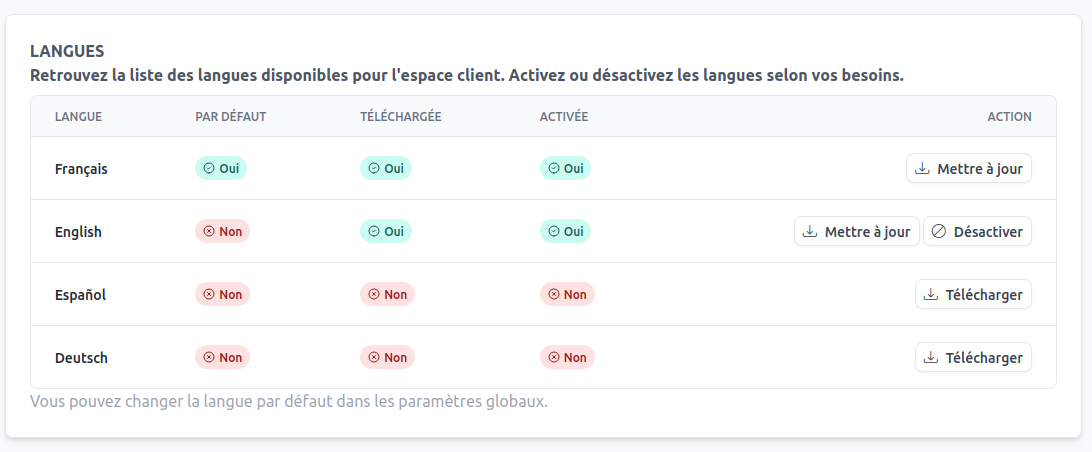
A platform available in your clients' native language significantly increases conversion rates. It's a minimal investment for maximum commercial impact.
Why Offer Multiple Languages?
Multilingualism is essential for:
- Expanding your market internationally without language barriers
- Improving customer experience by offering a native interface
- Increasing trust among non-French-speaking users
- Optimizing your SEO in different countries
It's like having multiple storefronts in different countries 🌍 — each customer feels at home, regardless of their native language.
Available Languages
CLIENTXCMS currently offers the following languages:
| Language | Code | Status |
|---|---|---|
| 🇫🇷 French | fr | Default language |
| 🇬🇧 English | en | Available |
| 🇪🇸 Spanish | es | Available |
| 🇩🇪 German | de | Available |
| 🇮🇹 Italian | it | Available |
Additional languages can be added upon community request. Translations are regularly maintained and improved.
Language Management
Download a Language
To add a new language to your platform:
- Access the language management page
- Locate the desired language in the list
- Click the "Download" button
- The language will be automatically installed and activated
Installation is instant and requires no restart. Your users can immediately change languages.
Update Translations
Language files are regularly improved to:
- Correct any translation errors
- Add translations for new features
- Improve linguistic quality
To update a language:
- The "Update" button appears for each installed language
- Click on it to download the latest version
- Translations are updated instantly
The "Update" button always remains visible, even if you have the latest version. This allows you to reinstall the language in case of problems or accidental customization.
Default Language Configuration
Set the Primary Language
The default language is displayed to:
- New visitors
- When the browser language is not available
- In system communications
To modify it:
- Go to
Settings>General Settings - Select the new default language
- Save the changes
Automatic Behavior
CLIENTXCMS automatically detects:
- The visitor's browser language
- The saved preference of the logged-in user
- The default language if no match
Impact on Your Platform
Translated Elements
When a language is activated, the following elements are translated:
- ✅ User interface: All menus, buttons, and messages
- ✅ Automated emails: Notifications, invoices, confirmations
- ✅ System messages: Errors, confirmations, alerts
- ✅ Static content: Legal pages, terms and conditions
- ✅ Theme configuration: Translatable fields defined by the theme (titles, descriptions, text content) — if the active theme supports database settings
Elements Requiring Manual Translation
Some content requires manual translation:
- 📝 Product descriptions: Via the product management interface
- 📝 Custom pages: Specifically created content
- 📝 Announcements and news: Marketing communications
- 📝 SEO metadata: Titles and descriptions for search engines
Translation Customization
Modify Existing Translations
If you want to adapt certain translations:
- Language files are stored in
/resources/lang/ - Each language has its own folder (e.g.,
fr/,en/) - Modify PHP files with caution
- Test your modifications in a development environment
Manual modifications will be overwritten during updates. Document your changes so you can reapply them.
Add Custom Translations
For your specific content:
// In your views or controllers
__('custom.my_translation_key')

// In the language file
'my_translation_key' => 'My custom translation',
Best Practices
For User Experience
- Visible selector: Place the language selector in the header
- Clear flags: Use recognizable icons
- Memorization: Preferences should be saved
- Consistency: Translate EVERYTHING or nothing
For SEO
- Localized URLs: Use subdomains or directories
- Hreflang tags: Indicate language alternatives
- Unique content: Avoid poor-quality automatic translations
- Multilingual sitemap: Include all versions
For Maintenance
- Documentation: Note your customizations
- Regular testing: Check after each update
- User feedback: Collect quality feedback
- Monitoring: Watch for new available languages
Advanced Use Cases
Conditional Activation
You can activate languages according to your needs:
- Testing phase: Start with 2-3 main languages
- Gradual expansion: Add languages based on demand
- Targeted markets: Only activate relevant languages
Integration with Modules
Some modules support multilingualism:
- Automatic product translation
- Multilingual invoice generation
- Customer support in multiple languages
Multilingualism is a major competitive advantage. Each language added opens your business to millions of new potential customers. The implementation effort is minimal compared to the growth potential.