Store
The store is the commercial heart of CLIENTXCMS. This is where your customers discover your services, compare your offers, and place orders. The objective is clear: create a smooth and professional purchasing experience that transforms your visitors into satisfied customers.
The store is a complete ecosystem that brings together several essential elements: products, groups, coupons, payment methods, and billing.
You can manage your store from:
Settings > Store Settings
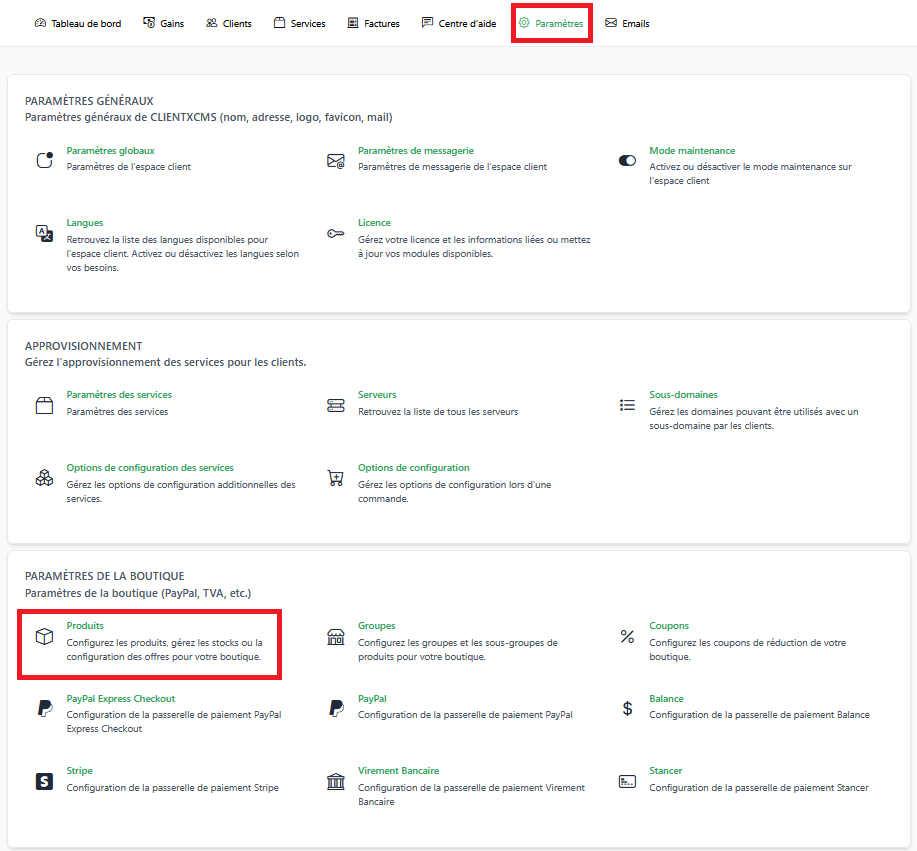
A well-organized store is a store that converts. Take the time to structure your offers, write clear descriptions, and configure payment methods adapted to your clientele.
Store Overview
Store Architecture
The ClientXCMS store is built around several key components:
- Products: The services you offer for sale (hosting, VPS, licenses, etc.)
- Groups: The categories that organize your products logically
- Coupons: Promotional codes to boost your sales
- Payment Methods: Gateways to receive payments
- Billing: Invoice management and accounting settings
Typical Customer Journey
- Discovery: The customer visits your store at
/store - Navigation: They explore the different product groups
- Selection: They choose a product and configure its options
- Cart: They add the product to the cart and possibly apply a coupon
- Payment: They pay for their order via their chosen payment method
- Delivery: The service is automatically provisioned after payment validation
User Interface
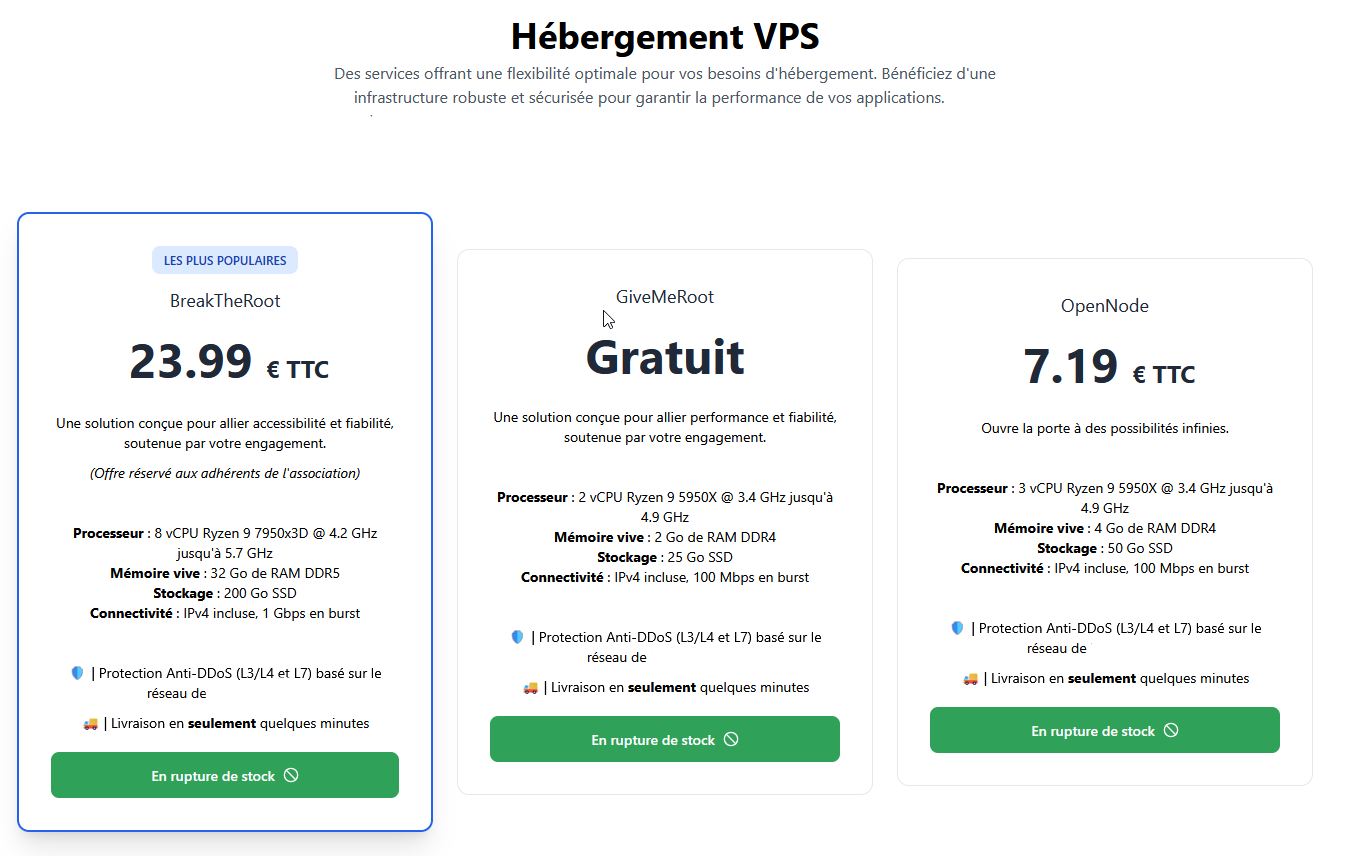
Customer-Side View
The store is publicly accessible at:
https://your-site.com/store
The interface presents:
- An overview of available product groups
- An intuitive category navigation system
- Detailed product pages with prices and options
- A persistent cart during the session
- A simplified ordering process
Administrator View
The administration interface allows you to:
- Manage all products and groups
- Track orders and payments
- Configure promotions and discounts
- Analyze commercial performance
- Customize the store appearance
Initial Configuration
Setup Steps
To configure your store, follow these steps in order:
-
Configure billing
- Define legal information
- Set up the invoice prefix
- Configure terms and conditions
-
Create product groups
- Organize your catalog structure
- Define main categories
- Add descriptions and images
-
Add products
- Create your service offers
- Define prices and billing cycles
- Configure technical options
-
Activate payment methods
- Configure at least one gateway
- Test transactions
- Verify webhooks
-
Create promotions (optional)
- Define discount coupons
- Plan marketing campaigns
Make sure you have configured at least one active payment method before opening your store to the public. Without this, your customers will not be able to complete their orders.
Order Management
Order Lifecycle
An order goes through several states:
| State | Description |
|---|---|
| Pending | Order created, payment not received |
| Paid | Payment validated, service being delivered |
| Active | Service delivered and operational |
| Suspended | Service temporarily disabled |
| Expired | Service reached end of term |
| Cancelled | Order cancelled before payment |
Automation
ClientXCMS automates several processes:
- Service creation after payment
- Sending confirmation emails
- Invoice generation
- Renewal reminders
- Suspension in case of non-payment
Integrations and Extensions
Provisioning Modules
The store integrates with many modules:
- Pterodactyl: Game server hosting
- Proxmox: VPS creation
- Plesk: Managed web hosting
- ProxmoxVE: Advanced virtualization
- And many more...
Payment Gateways
Several options are available:
- PayPal: Standard and Express Checkout
- Stripe: Credit cards and wallets
- Bank Transfer: Manual payments
- Customer Balance: Prepaid credit
- Stancer: European solution
The ClientXCMS store is designed to grow with your business. Start simple, then gradually enrich your catalog and features according to your customers' needs.
Additional Resources
To learn more about configuring your store, see:
🗃️ Payment Gateways
7 items
📄️ Products
In CLIENTXCMS, a product corresponds to a service you offer for rent in your store.
📄️ Groups
In CLIENTXCMS, a group corresponds to a logical category of products that you offer in your store.
📄️ Coupons
In CLIENTXCMS, a coupon corresponds to a discount code that you offer to your customers in your store.