Self-hosted
This page guides you through installing ClientXCMS Next Gen on a VPS or dedicated server. It targets a Debian 12 installation with PHP 8.3, MariaDB, and an Apache or Nginx web server.
Self-hosting is recommended if you want to manage the server, updates, backups, and system configuration yourself. If you want a more automated installation, see the Cloud, Plesk, or Docker installation instead.
This page complements the technical requirements. The commands below are intended for Debian 12 and may vary depending on your distribution.
Prerequisites
Before you begin, make sure you have the following:
- A Debian 12 VPS or dedicated server with SSH access.
- A user that can run
sudo. - A domain name pointing to the server.
- An SSL certificate to use ClientXCMS over HTTPS.
- A valid ClientXCMS license.
- Your ClientXCMS OAuth credentials, available from your license management page in the customer area.
- At least 100 MB of disk space available for the application, excluding backups and customer files.
Server preparation
Update the server and install the base tools:
sudo apt update
sudo apt upgrade -y
sudo apt install ca-certificates apt-transport-https software-properties-common wget curl git unzip nano lsb-release -y
Install PHP 8.3 and the required extensions:
curl -sSL https://packages.sury.org/php/README.txt | sudo bash -x
sudo apt update
sudo apt install php8.3 php8.3-fpm php8.3-cli php8.3-common php8.3-curl php8.3-bcmath php8.3-intl php8.3-mbstring php8.3-mysql php8.3-gd php8.3-xml php8.3-zip php8.3-fileinfo php8.3-opcache -y
Check the installed version:
php -v
Install Composer:
php -r "copy('https://getcomposer.org/installer', 'composer-setup.php');"
php composer-setup.php
sudo mv composer.phar /usr/local/bin/composer
php -r "unlink('composer-setup.php');"
Install Node.js LTS with NVM:
curl -o- https://raw.githubusercontent.com/nvm-sh/nvm/v0.40.0/install.sh | bash
source ~/.bashrc
nvm install --lts
nvm use --lts
Check the available versions:
node -v
npm -v
composer --version
Retrieving the source code
Create the installation folder:
sudo mkdir -p /var/www/clientxcms
sudo chown -R $USER:www-data /var/www/clientxcms
cd /var/www/clientxcms
- Recommended release archive
- Advanced Git
Download the latest ClientXCMS archive from the download area, then upload it to your server, for example to /tmp/clientxcms.zip.
Then extract the archive into the installation folder:
unzip /tmp/clientxcms.zip -d /tmp/clientxcms-release
cd /tmp/clientxcms-release/ClientXCMS-*
cp -R . /var/www/clientxcms/
cd /var/www/clientxcms
The release archive is recommended for production installations because it matches a published version.
If you prefer working with Git, clone the official repository:
cd /var/www
git clone https://github.com/ClientXCMS/ClientXCMS.git clientxcms
cd /var/www/clientxcms
You can then update the instance with:
git fetch --all --prune
git checkout master
git pull origin master
This method follows the repository's main branch. For production use, prefer a stable release archive.
Web server configuration
The web server must point to the ClientXCMS public folder. The examples below do not replace SSL configuration: in production, configure HTTPS with your certificate before finalizing the installation.
- Recommended Nginx
- Apache
Install Nginx:
sudo apt install nginx -y
Create the vhost:
sudo nano /etc/nginx/sites-available/clientxcms.conf
Configuration example:
server {
    listen 80;
    server_name your-domain.com www.your-domain.com;
    root /var/www/clientxcms/public;

    index index.php index.html;

    location / {
        try_files $uri $uri/ /index.php?$query_string;
    }

    location ~ \.php$ {
        include snippets/fastcgi-php.conf;
        fastcgi_pass unix:/run/php/php8.3-fpm.sock;
        fastcgi_param SCRIPT_FILENAME $document_root$fastcgi_script_name;
        include fastcgi_params;
    }

    location ~ /\.ht {
        deny all;
    }
}
Enable the site, then reload Nginx:
sudo ln -s /etc/nginx/sites-available/clientxcms.conf /etc/nginx/sites-enabled/clientxcms.conf
sudo nginx -t
sudo systemctl reload nginx
Install Apache and the PHP module:
sudo apt install apache2 libapache2-mod-php8.3 -y
sudo a2enmod rewrite
Create the vhost:
sudo nano /etc/apache2/sites-available/clientxcms.conf
Configuration example:
<VirtualHost *:80>
    ServerName your-domain.com
    ServerAlias www.your-domain.com
    DocumentRoot /var/www/clientxcms/public

    <Directory /var/www/clientxcms/public>
        Options FollowSymLinks
        AllowOverride All
        Require all granted
    </Directory>

    ErrorLog ${APACHE_LOG_DIR}/clientxcms-error.log
    CustomLog ${APACHE_LOG_DIR}/clientxcms-access.log combined
</VirtualHost>
Enable the site, then reload Apache:
sudo a2ensite clientxcms.conf
sudo apache2ctl configtest
sudo systemctl reload apache2
Database
Install MariaDB:
sudo apt install mariadb-server -y
sudo mysql_secure_installation
Connect to MariaDB:
sudo mysql
Create the database and user:
CREATE DATABASE clientxcms CHARACTER SET utf8mb4 COLLATE utf8mb4_unicode_ci;
CREATE USER 'clientxcms'@'localhost' IDENTIFIED BY 'replace_this_password';
GRANT ALL PRIVILEGES ON clientxcms.* TO 'clientxcms'@'localhost';
FLUSH PRIVILEGES;
EXIT;
Replace replace_this_password with a strong password and keep it for the .env file.
Environment configuration
Copy the example file:
cd /var/www/clientxcms
cp .env.example .env
nano .env
Fill in the main values:
APP_ENV=production
APP_URL=https://your-domain.com

OAUTH_CLIENT_ID=your_client_id
OAUTH_CLIENT_SECRET=your_client_secret

DB_CONNECTION=mysql
DB_HOST=localhost
DB_PORT=3306
DB_DATABASE=clientxcms
DB_USERNAME=clientxcms
DB_PASSWORD=replace_this_password

QUEUE_CONNECTION=database
CACHE_STORE=file
SESSION_DRIVER=file
Also configure the mail variables according to your SMTP provider so ClientXCMS can send transactional emails.
In nano, use Ctrl + X, then Y, then Enter to save and quit.
ClientXCMS installation
Install the PHP dependencies:
cd /var/www/clientxcms
composer install --optimize-autoloader --no-dev
Initialize Laravel:
php artisan key:generate
php artisan migrate --force --seed
php artisan storage:link
php artisan optimize:clear
Apply the required permissions for the web server:
sudo chown -R www-data:www-data /var/www/clientxcms/storage /var/www/clientxcms/bootstrap/cache
sudo chmod -R 775 /var/www/clientxcms/storage /var/www/clientxcms/bootstrap/cache
Asset compilation
Install the JavaScript dependencies, then compile the assets:
cd /var/www/clientxcms
npm install
npm run build
If you install or activate a theme later, run npm run build again.
Scheduled tasks and queues
Add the Laravel scheduler to the web server user's crontab:
sudo crontab -u www-data -e
Add this line:
* * * * * php /var/www/clientxcms/artisan schedule:run >> /dev/null 2>&1
To process background tasks, install Supervisor:
sudo apt install supervisor -y
sudo nano /etc/supervisor/conf.d/clientxcms-worker.conf
Add the following configuration:
[program:clientxcms-worker]
process_name=%(program_name)s_%(process_num)02d
command=php /var/www/clientxcms/artisan queue:work --sleep=3 --tries=3 --timeout=90
directory=/var/www/clientxcms
autostart=true
autorestart=true
user=www-data
numprocs=1
redirect_stderr=true
stdout_logfile=/var/log/clientxcms-worker.log
Reload Supervisor:
sudo supervisorctl reread
sudo supervisorctl update
sudo supervisorctl start clientxcms-worker:*
Finalization
Open your browser at the URL configured in APP_URL:
https://your-domain.com
Follow the installation wizard, enter your hosting company name, then connect your license with the OAuth credentials retrieved from the ClientXCMS customer area.
Extension purchase
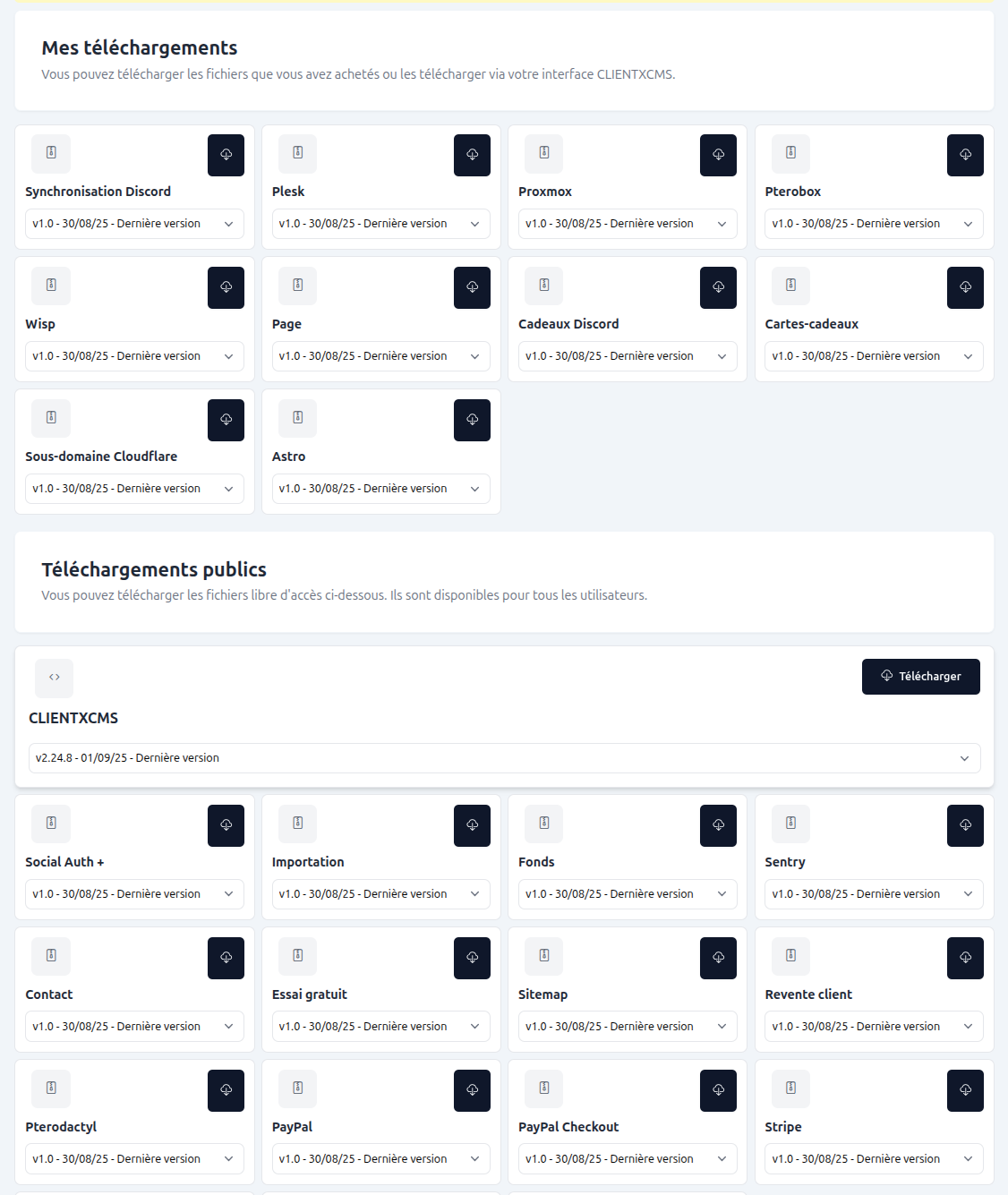
If you purchase an extension and the following message appears during activation:
"The composer.json file was not found."
Download the extension archive from the customer area, then extract it on your ClientXCMS instance.
Migration from a cloud version
If you want to migrate a cloud installation to your server:
- Download a database backup from the administration or PHPMyAdmin.
- Open a support request to obtain the encryption key of your cloud instance.
- Import the backup into your local database.
- Replace the encryption key in your
.envfile with the cloud instance encryption key. - Run
php artisan migrate --force --seed. - Run
php artisan storage:link. - Create the
storage/installedfile if the installation wizard should not run again.
Common problems
Jsonable interface not found
If you get the Interface "DragonCode/Contracts/Support/Jsonable" not found error, install the missing dependency:
composer require dragon-code/contracts
php artisan optimize:clear
Theme activated but not displayed
If an activated theme is not displayed, add this variable to .env:
APP_REVERSE_PATHS=true
Then clear the caches:
php artisan optimize:clear
Logo or uploaded files not displayed
Check the storage link and permissions:
php artisan storage:link
sudo chown -R www-data:www-data storage bootstrap/cache
sudo chmod -R 775 storage bootstrap/cache
php artisan cache:clear
Permission issues in logs
If log files are created with the wrong user, reapply permissions:
sudo chown -R www-data:www-data storage/logs
sudo chmod -R 775 storage/logs
Also make sure cron tasks and Supervisor run as the www-data user.