Help Center Settings
In CLIENTXCMS, help center settings define the behavior and operational rules of your support system. The goal is strategic: optimize support efficiency, automate repetitive processes, and ensure a consistent experience for your clients and team. Proper configuration improves productivity, reduces manual workload, and maintains a high level of service.
Well-configured settings transform your help center into a well-oiled machine. Each automation saves you time to focus on complex cases.
Why Configure These Settings?
Help center configuration is essential for:
- Automating management of inactive tickets
- Controlling interactions with clients
- Securing file exchanges
- Integrating with your external tools
- Maintaining service quality
It's like adjusting the settings of an industrial machine ⚙️ — the more precise it is, the more efficient and reliable.
Automatic Ticket Management
Automatic Closure
Auto-close after inactivity | (number of days) Defines after how many days a ticket without activity will be automatically closed.
Recommended values:
- 7 days: Standard for most cases
- 3 days: High-responsiveness support
- 14 days: Complex projects requiring more time
- 0: Disables automatic closure
- Automatically cleans abandoned tickets
- Maintains accurate statistics
- Frees up workload for teams
- Encourages client responsiveness
Controlled Re-opening
Re-opening authorization | (number of days) Allows clients to reopen their closed tickets for a limited period.
Available options:
- 7 days: Recommended standard delay
- 0: Disables re-opening
- -1: Unlimited re-opening time
Use cases:
- 7 days: For standard technical problems
- 14 days: For migrations or complex projects
- 0: To force new tickets and avoid confusion
- -1: For premium support with long-term follow-up
Unlimited re-opening can create very old tickets that are difficult to manage. Prefer a reasonable delay.
Webhooks
Webhook URL: URL of your endpoint to receive ticket notifications (POST JSON). Use an HTTPS URL if possible.
- If the provided URL is a Discord webhook (e.g., https://discord.com/api/webhooks/xxxxx), notifications will automatically appear as embeds (screenshot below).
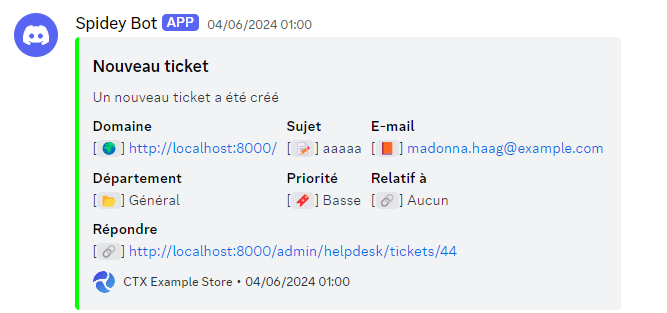
- If you use a custom webhook, CLIENTXCMS will send an HTTP POST request with a structured JSON payload. Example:
- Ticket creation
- Ticket closure
- Staff reply
- Customer reply
{
   "payload": {
        "action": "helpdesk_create",
        "_url": "https://example.com/admin/helpdesk/tickets/1",
        "ticketid": "1",
        "customer_url": "https://example.com/admin/customers/1",
        "department": "General",
        "priority": "Low",
        "subject": "Test ticket",
        "message": "Hello, here is the ticket content.",
        "customername": "Martin Dev",
        "customeremail": "test@clientxcms.com",
        "appname": "CLIENTXCMS",
        "appurl": "https://example.com/"
  }
}
{
   "payload": {
        "action": "helpdesk_closed",
        "_url": "https://example.com/admin/helpdesk/tickets/1",
        "ticketid": "1",
        "customer_url": "https://example.com/admin/customers/1",
        "department": "General",
        "priority": "Low",
        "subject": "Test ticket",
        "customername": "Martin Dev",
        "customeremail": "test@clientxcms.com",
        "appname": "CLIENTXCMS",
        "appurl": "https://example.com/"
	}
}
{
    "payload": {
        "action": "helpdesk_answered_staff",
        "_url": "https://example.com/admin/helpdesk/tickets/1",
        "ticketid": "1",
        "customer_url": "https://example.com/admin/customers/1",
        "department": "General",
        "priority": "Low",
        "subject": "Test ticket",
        "message": "Hello, here is the staff reply content.",
        "customername": "Martin Dev",
        "customeremail": "test@clientxcms.com",
        "appname": "CLIENTXCMS",
        "appurl": "https://example.com/"
    }
}
{
    "payload": {
        "action": "helpdesk_answered_customer",
        "_url": "https://example.com/admin/helpdesk/tickets/1",
        "ticketid": "1",
        "customer_url": "https://example.com/admin/customers/1",
        "department": "General",
        "priority": "Low",
        "subject": "Test ticket",
        "message": "Hello, here is the customer reply content.",
        "customername": "Martin Dev",
        "customeremail": "test@clientxcms.com"
        "appname": "CLIENTXCMS",
        "appurl": "https://example.com/"
    }
}
Useful notes:
action: indicates the event (e.g.,helpdesk_create,helpdesk_answered_staff,helpdesk_answered_customer)._url: internal link to ticket editing- Values are in string format. Adapt your server-side processing according to your needs.
Attachment Management
File Activation
Allow attachments | (switch) Enables or disables the ability for clients to attach files to their tickets.
Attachment benefits:
- Screenshots for visual problems
- Error logs for technical diagnosis
- Documents for administrative requests
- Evidence for complaints
Security and Limitations
Maximum size | (MB) Limits the size of files that clients can attach.
Recommendations by usage type:
| Support Type | Recommended Size | Justification |
|---|---|---|
| General support | 5 MB | Screenshots and light documents |
| Technical support | 10 MB | Logs and configuration files |
| Developer support | 25 MB | Code archives and dumps |
| Limited server | 2 MB | Disk space saving |
Allowed File Types
Accepted extensions | (comma-separated list) Defines which file types are accepted in tickets.
Default configuration: jpg,jpeg,png,doc,docx,xls,xlsx
Recommended configurations:
Standard Support
jpg,jpeg,png,gif,pdf,doc,docx,txt,log
Advanced Technical Support
jpg,jpeg,png,gif,pdf,doc,docx,txt,log,zip,rar,sql,json,xml
Secure Support (restrictive)
jpg,jpeg,png,pdf,txt
Types to absolutely avoid:
.exe, .bat, .cmd: Executable files.php, .js, .html: Potentially malicious scripts.scr, .pif: Extensions often used by malware
Best practices:
- Limit to strictly necessary types
- Scan files with antivirus
- Regularly check suspicious uploads
Established Business
Auto-close: 7 days
Re-opening: 14 days
Attachments: Enabled (10 MB)
Allowed types: jpg,png,pdf,doc,docx,txt,log
Webhook: CRM system
Specialized Technical Support
Auto-close: 14 days
Re-opening: -1 (unlimited)
Attachments: Enabled (25 MB)
Allowed types: jpg,png,pdf,txt,log,zip,sql,json
Webhook: Slack + monitoring
Secure Organization
Auto-close: 5 days
Re-opening: 0 (disabled)
Attachments: Enabled (2 MB)
Allowed types: jpg,png,pdf,txt
Webhook: Internal audit system
Performance Optimization
Metric Monitoring
Regularly analyze:
- Re-opening rate: Indicator of resolution quality
- Closure time: Automation efficiency
- Attachment volume: Impact on disk space
- File types: Adaptation to real needs
Preventive Maintenance
- Periodic cleanup: Delete old files
- Settings review: Adjust according to evolution
- Webhook testing: Check connectivity regularly
- Team training: Ensure everyone masters the settings
Help center settings should evolve with your business. What works for a small team may not suit a larger organization. Regularly review and adjust according to your metrics and feedback.